The Colour Out of Space
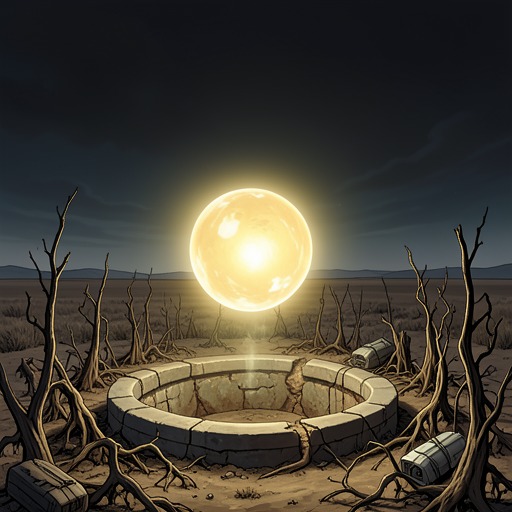
The Colour Out of SpaceThe Colour Out of Space is an alien presence that enters the story as an inexplicable feature of a meteorite and becomes the force associated with the Gardner family’s decline and the farm’s destruction. It is recognized less by any stable form than by a hue that resists ordinary description, a recurring sign linking a laboratory specimen, altered vegetation, a troubled well, and the final departure from the valley. The account makes its effects increasingly evident while leaving its origin and material nature beyond secure human understanding.
Discovery and Appearance
When professors examine the meteorite near the well, they find a large coloured globule embedded within its shrinking substance. The hue resembles bands in the meteorite’s unusual spectrum, but calling it a colour is itself an approximation: the observers have no familiar comparison that adequately describes it. The glossy sphere seems at once brittle and hollow. A professor strikes it, and it bursts; nothing comes out, and the object vanishes, leaving a hollow space about three inches across. The observers suspect that other globules may be concealed in the meteorite as its outer material wastes away.
The globule is thus presented as both an object that can be examined and something that defeats the ordinary conditions of observation. Its apparent solidity gives way in an instant, while its disappearance yields no residue or explanation. That contrast becomes characteristic of the Colour throughout the story: it leaves recognizable effects, but those effects do not make it intelligible or reliably containable.
Scientific Examination and Its Limits
A further fragment of the meteorite carries a related substance to the college laboratory, where its properties prove striking but inconclusive. It is almost plastic, retains heat, responds to magnetism, and gives off a slight luminosity. Powerful acids cool it somewhat; it has an unknown spectrum, wastes away in air, and reacts destructively with silicon compounds. None of these observations identifies it. The scientists conclude only that it is not terrestrial and follows properties and laws outside their experience.
The testing also supplies no dependable means of preserving the material. Chips from the original fragment, left in a glass beaker, disappear overnight, leaving a charred mark on the wooden shelf. The main meteorite then attracts repeated lightning strikes during a thunderstorm; afterward, it is gone, and digging around the well finds nothing. A fragment carefully enclosed in lead lasts a week before disappearing without residue. The investigations end without a classification, and even the professors later feel uncertain that they saw the substance at all. Measurement records changes around it, but cannot turn those changes into a known account of what it is.
The Colour and the Gardner Family
The Colour’s connection to the farm becomes clearer through Nahum Gardner’s final account to Ammi Pierce. Nahum associates it with the strange vegetation that appeared earlier and says that it lived in the well. He describes it as a kind of smoke and believes that it draws the life from living things. He links the decline of his family and the farm to the meteorite, and recalls the globule that the professors removed and broke, wondering whether there were more like it. His account connects the laboratory discovery to the family’s experience, without explaining the Colour’s purpose or giving it a comprehensible motive.
The well becomes the central point in this connection. Nahum identifies its water as dangerous and recalls that Zenas Gardner never returned from it; Merwin Gardner had also disappeared. He fears that Nabby Gardner is being affected, noting that her face sometimes takes on the same colour toward evening. These details make the Colour’s effects both environmental and familial: the altered plants, the unsafe well, and the family’s losses are not separate mysteries in Nahum’s understanding, but parts of one spreading influence. Ammi reports the deaths of Nahum and Nabby to the authorities, along with the already known death of Thaddeus Gardner and the disappearances of Merwin and Zenas.
The Well’s Glow and Departure
After nightfall, the men gathered at the farm see a distinct glow rising from the well. Ammi recognizes its colour from the globule and from the abnormal spring vegetation, and connects it with the strange vapour he had seen near Nahum shortly before Nahum’s death. The recurrence gives the hue evidentiary force: it is not merely an unusual feature of the meteorite, but a visible link between the original discovery and the later events at the farm.
The farm then appears lit by the same alien colour. As Ammi and the others retreat by way of the fields and Chapman’s Brook, they look back and see the glow over the buildings, trees, and remaining vegetation. The Colour rises vertically into the sky and disappears through a round opening in the clouds. Almost immediately, the farm is engulfed in a violent eruption of strange light and fragments. The men do not return to investigate the site that night. The sequence makes the Colour’s departure an escape rather than a scientific resolution: it leaves the farm devastated, but the observers do not establish where it has gone or whether the whole presence has departed.
Aftermath and Uncertainty
The narrator’s account preserves that uncertainty rather than resolving it. The people of Arkham avoid discussing the strange days, and the professors who saw the meteorite and globule are dead. The narrator reasons that there were other globules, that one may have fed and escaped, and that another may still lie in the well. These remain conjectures, supported by the Colour’s repeated association with the farm and by the troubling appearance of the ground above the well, not by a final examination of its contents.
The narrator also notes reports that the blight advances slowly and that some trees seem to glow or move unnaturally at night. Such reports suggest persistence, but do not establish exactly what remains or how it is sustained. The scientific description of the presence as gas is likewise only an approximation: its behavior does not conform to the laws by which familiar matter is understood. The Colour therefore gives the story a recurring sign without a secure translation. Its hue makes separate events perceptibly related, while its resistance to classification keeps the larger explanation out of reach. The evidence supports the reality of a terrible influence and its association with the meteorite, the well, and the ruined farm; it does not disclose a complete account of the force behind them.